









"High-tech is not only an economic engine, but also a social engine"
Dana Nissel, CEO of Anu Banu, was speaking at the National Economic Conference. Yohanan Mali, Director General of the Ministry of the Negev, Galilee and National Resilience: "When you are within driving distance of the center, you are not a periphery"; Nadir Izrael, co-founder and CTO of Armis, said that "AI is the democratization of high-tech"; And Michal Sarig-Kaduri, Director of Government Relations at Wix, added: "AI is just infrastructure - those who create opportunities are leadership."
"The concept of the periphery should disappear from our lives. It is not a destiny we need to perpetuate," said Yohanan Mali, Director General of Israel's Ministry of the Negev, Galilee and National Resilience, at the National Economic Conference hosted by Calcalist, Bank Leumi and Clal.
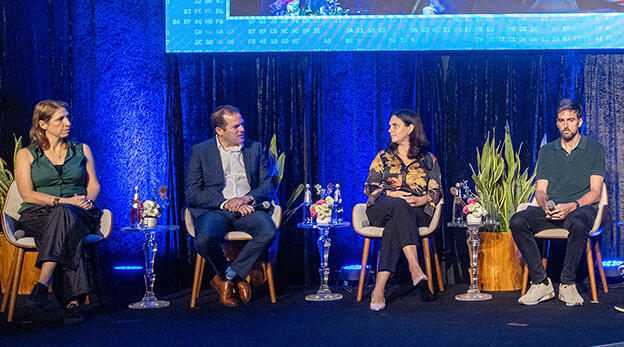
During a panel on the role of high-tech in reducing social gaps and integrating artificial intelligence into local authorities and traditional industries, participants argued that technology can become a powerful growth engine for Israel's peripheral regions, but only if the government, local authorities, and the private sector actively embrace it. The panel was moderated by Calcalist reporter Meir Orbach.
Why do you think the term "periphery" is no longer relevant?
Yohanan Mali: "The term 'periphery' comes from the American concept of the suburbs. It is not a destiny we need to perpetuate. Most of the journey has already been made, and this term should disappear from our lives. If you are within driving distance of the country's economic center, you are not truly in the periphery.
"We are still far from where we want to be, and there are many challenges ahead, but there is also a gap between reality and perception. Take Dimona, for example. Its education system is one of the best in the country, yet some people still joke that they teach camel riding there."
1 View gallery
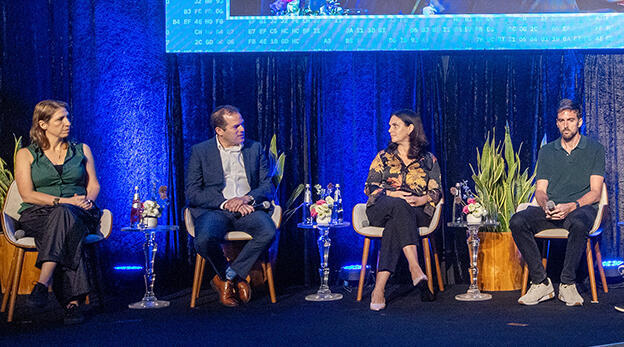
National Economic Conference panel (from right): Nadir Izrael, Dana Nissel, Meir Orbach, Michal Sarig-Kaduri
(Ido Erez)
But we still don't feel the presence of high-tech in places like Metula, Kiryat Shmona, Yeruham or Sderot.
Mali: "The state must step in where the level of risk is disproportionate. Investing in Kiryat Shmona today involves risk, and that's exactly why the government needs to be there. It's not just about funding or salaries, it's also about changing the mindset.
"People working in high-tech operate on a global level but still receive public services designed in the 1980s and 1990s. If local authorities adopt AI, they can transform themselves even before high-tech companies arrive. Technology can help propel municipalities forward."
How do we turn high-tech into a social engine?
Dana Nissel, CEO of Anu Banu: "Our vision is that high-tech should be not only an economic engine, but also a social one. It has the power to create a better future for Israeli society. To reduce social gaps, it must work in partnership with local authorities and traditional industries. AI can also become a bridge between high-tech and industry, creating real value."
To what extent can opportunity change lives?
Nadir Izrael, co-founder and CTO of Armis: "I see myself as a product of social mobility. I grew up in Kiryat Ata, studied in a yeshiva high school, and was raised by a mother who is disabled and nearly blind. Despite those challenges, I received opportunities at the right moments, I served in Unit 8200, studied at the Technion, worked at Google, and a decade ago co-founded Armis.
"I wasn't given special treatment. I was given an opportunity. Behind every success story is a system that knows how to create opportunities for people."
There is a perception that high-tech is becoming disconnected from Israeli society.
Michal Sarig-Kaduri, Director of Government Relations at Wix: "We are actually in the middle of a process in which high-tech is becoming more deeply involved in Israeli society. Although the industry is facing significant business challenges of its own, it has not withdrawn from the social arena.
"We also need to stop viewing high-tech's contribution solely through the lens of ESG. The industry's impact extends far beyond corporate social responsibility."
How can AI help local authorities and traditional industries?
Mali: "On my way here, I spoke with an entrepreneur developing AI solutions for local authorities. If I see a steel factory in northern Israel that doesn't know how to implement AI, perhaps junior professionals who haven't yet found a place in high-tech can help bring that technology into the business.
"Not every junior needs to work at a tech company. High-tech expertise can be embedded across the broader economy. The public sector also has a responsibility because it holds much of the country's data."
Sarig-Kaduri: "We talk about AI as though it is the solution, but leadership is what creates opportunities. AI is simply infrastructure. If we don't use it properly, it won't create meaningful change. It can shorten processes and make capabilities accessible to everyone, but real transformation requires initiative and leadership."
Izrael: "AI is democratizing high-tech. Today, any factory owner in Kiryat Shmona can open Claude and start managing their business more effectively. AI doesn't replace people, people who use AI replace people who don't."



