










The new worker must be “AI-fit,” says Amdocs executive
Organizations must build an “AI gym” for employees as software shifts from tools to autonomous agents.
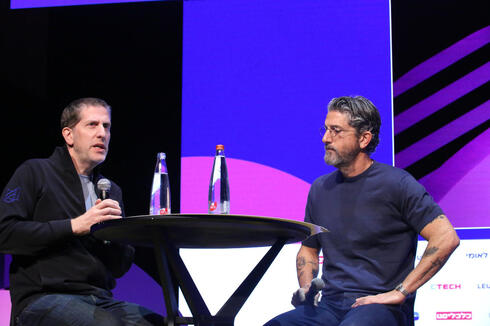
“The contract between organizations and employees has changed. In the past, I would recruit a programmer or designer because of their expertise in Java or Photoshop. Today, an employee needs to be ‘AI-fit’, able to use the relevant tools independently to deliver maximum productivity while continuously maintaining and upgrading those skills. Our responsibility as employers is to provide the ‘AI gym.’ In other words, employees must stay on top of developments, and organizations must provide the platforms that allow them to remain AI-fit,” said Gil Rosen, CMO at Amdocs, in a conversation with Guy Rosen, VP, Product Management & CISO at Meta, at Calcalist’s Tech TLV conference in collaboration with Leumi.
According to Guy Rosen, who leads Meta’s AI transformation across an organization of nearly 100,000 employees, implementing AI at such scale is extraordinarily complex. “You can’t just take an off-the-shelf product,” he said. “We have billions of lines of code written in languages that are largely internal to Meta, so the infrastructure itself has to be adapted for AI. Already today, 70% of our code updates involve AI agents. In 2025, overall engineering productivity increased by 30%, and among superusers we saw gains of up to 80%. If you look at how younger engineers work, they manage several AIs simultaneously, their role has become one of coordination and orchestration. This isn’t a distant future; it’s happening now.”
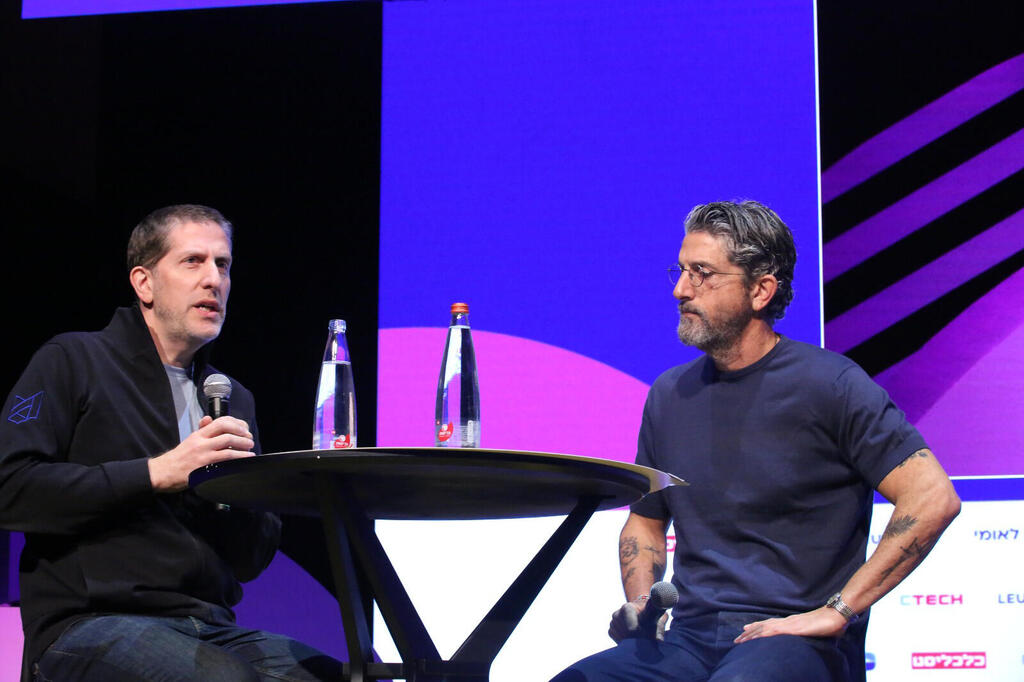
Gil Rosen argued that the very nature of software is being redefined. “Software and software services as we knew them have ceased to exist,” he said. “Two weeks ago, we launched an agent operating system for the telecommunications market, AOS. The model in which software companies develop capabilities and sell them as standalone products is over. We realized we must take our expertise in the communications world, serving companies from AT&T in North America to Singtel in Singapore, and provide customers with a new corporate brain. AI is no longer a feature; it has become the core.”
“When we deliver AOS, we don’t just provide software,” he continued. “We provide software together with dozens, hundreds, even thousands of agents, digital workers in essence. These agents operate our software and third-party systems end-to-end through intelligent automation. The era of delivering isolated components within the vast architecture of a telecom company is over. We deliver the software together with its operating system.”
One unexpected challenge, he added, is branding. “These agents are going to interact directly with customers, so they must have personality. I was VP of Marketing at Bezeq, and I know that under no circumstances can my agent sound like a Cellcom or Partner agent. Every brand needs its agents to embody its unique identity, whether they are friendly, humorous, formal, or concise. That is part of the operating system: not only business processes, but also how agents behave.”
Addressing cybersecurity concerns in the age of AI agents, Guy Rosen noted the tension between innovation and risk. “People in roles like mine face constant pressure: employees want all the tools, immediately, and with full access to data, and for good reasons, because it helps them work better. But we must be careful. As a company serving billions of users, we have a major responsibility to implement these tools wisely.”
Meta, he explained, has developed a multi-layered defense strategy. “First, at the design stage we apply what we call the ‘Agent Rule of Two,’ which defines an agent’s capabilities in advance to reduce vulnerabilities. Second, we must address new forms of attack such as prompt injection. Third, all organizational systems, monitoring, authorization, compliance, must be adapted to a reality in which much of the company’s activity is performed by agents rather than humans.
“We’ve released many of these tools as open source, by the way. We have PromptGuard, we’ve published a blog about the Agent Rule of Two, and a range of other resources, because we understand that this isn’t just our challenge, it’s a challenge for the entire industry. And I say this as an Israeli: there is an incredibly impressive cybersecurity industry here, and a huge opportunity in the field of how to implement AI within organizations. There is a tremendous opportunity for the cyber sector, this could be the next springboard for the entire Israeli ecosystem.”



